



Kangra Miniatures: A Perspective
Oct 20, 2023
3 min read
To understand any art, one has to view it as an organism with its own soul, forms of expression and conventions. Kangra Miniature Paintings, originating from the princely hill state of Kangra in Himachal Pradesh, unveils itself as an organic entity with a soulful presence. These paintings were never hung on the walls or framed, but kept packed in pieces of cloth, and brought out on rare occasions to enjoy in seclusion. Reading these paintings is an intimate experience, a one on one conversation, and if you’re lucky enough, the painting talks back to you. These miniature paintings glorified refinement, restraint and divinity of beauty. Every art is a language. What the words cannot express is sometimes conveyed in painting through space enclosed in line and dabbed in colours. Kangra Painting is an art both of line and colour. A vigorous rhythmical line is the basis of this art. It is also an art of colour, and the artists revelled in the use of pure blues, yellows, reds and greens. These jewel-like miniatures were executed with such care and skill that the passage of time has not dimmed their glowing colours. It is an art flooded with sunlight and colour, charged with spiritual feeling, and is still strongly felt, and kindles deep emotion in the beholder.
Above all, these paintings are the visual record of a culture, the warm sensuous humanism of Vaishnavism, which found expression in poetry and ultimately in paintings of utmost delicacy and beauty. They mirror their age and humanity and the ideals which inspired them. Vaishnavism which kindled the creative enthusiasm of the age preached the religion of love. Like the love of a husband for his wife, love of a kind most intimate, ecstatic and passionate. In the Kangra Valley it inspired an art which reached the heights of joyous aesthetic harmony, which its Mughal predecessor failed to achieve. Kangra artists dealt with the eternal theme of human love expressed in the legend of Rädha and Krishna. Most Kangra Paintings are inspired by the Gita Govinda, for those not familiar with The Gita Govinda, it is one of the last great Sanskrit utterances of our country, and was written in the 12th century in the eastern part of India by a poet called Jaydev. The Gita Govinda revolves around themes of love, affection, separation, apologies, repentance and reconciliation between Radha and Krishna. It is a symbolic love song based on the poet’s spiritual experience. Krishna is the human soul attached to earthly pleasures and Radha, the nayika, is Divine Wisdom. The gopis who tempt Krishna from Radha are the five senses of smell, sight, touch, taste and hearing, and the return of Krishna to Radha, his first love, is regarded as the return of the repentant sinner to God.
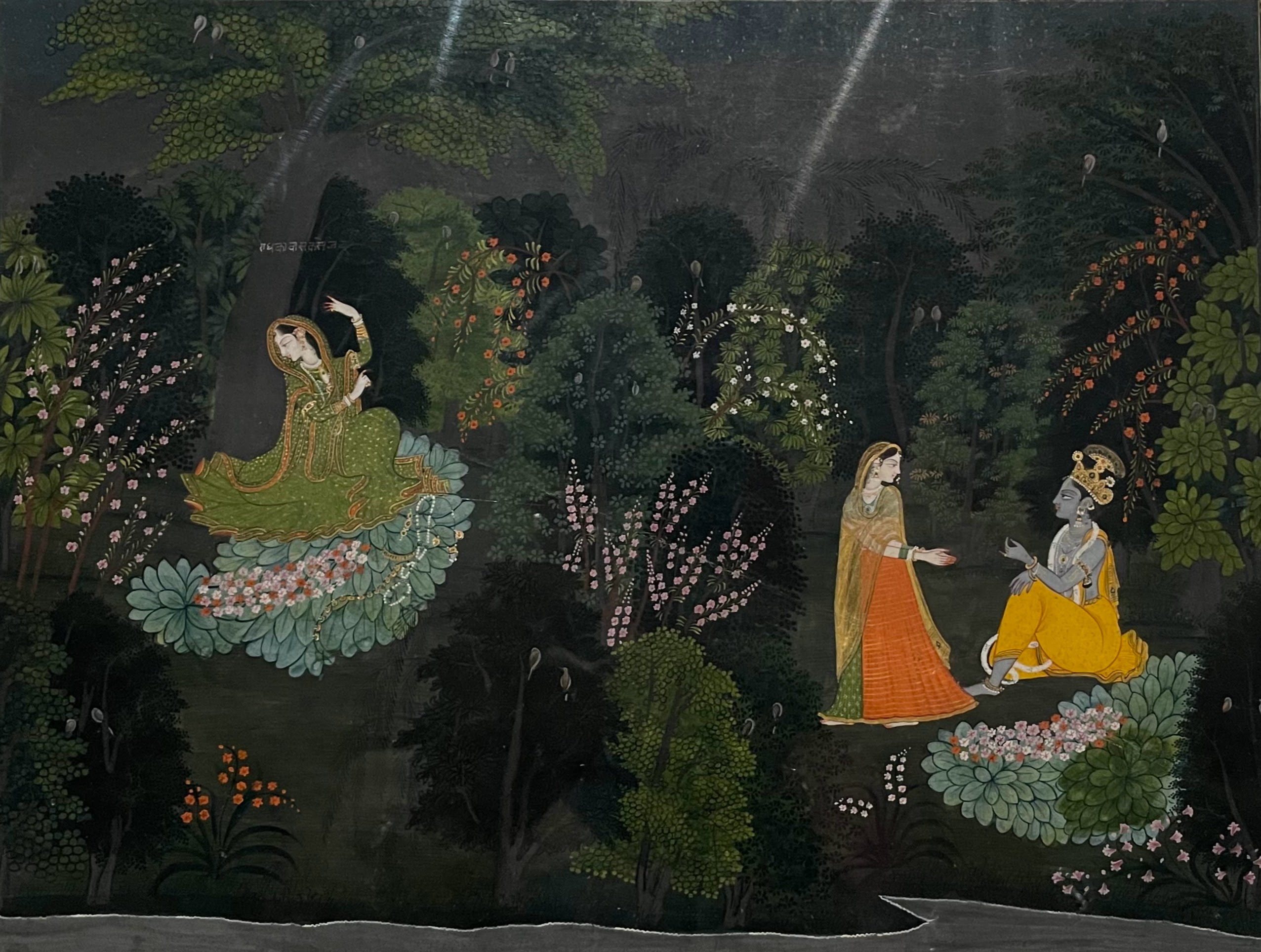
In this scene (Figure 1), Jayadeva narrates the story of the separation and reconciliation of Radha in the form of a pastoral drama. The actors are Krishna, Radha, the gopis and the dutika, the lovers' messenger. The scene is laid in the forest of Vrindavan. Radha sits under a tree, and Krishna dances with the gopis at a distance on the bank of the Yamuna. The air is heavy with the fragrance of flowers. The beautiful Radha, whose limbs are like flowers of the madhavi creeper, looks for Krishna in the trackless forest. While Krishna revels with the gopis, forgetting Radha’s devotion, a damsel brings news of Krishna’s whereabouts to Radha in the blossoming spring. A dutika approaches him, and describes the great attachment and affection of Radha for Krishna, and how her love for him is never ending. Radha is the human soul in search of God and ultimately her love and devotion attract Krishna, who leaves the gopis to search for Radha. The messenger then goes to Radha to tell her that Krishna waits for her eagerly in a bower. Radha prepares to meet Krishna, adorning herself with necklaces of pearls, gold bracelets and a pearl nose-ring. She meets Krishna under the shade of tamala trees(indian bay leaf) decorated with atimukta creeper (madhumalti) laden with blossoms.
Figure 1. Krishna Brading Radha’s Hair
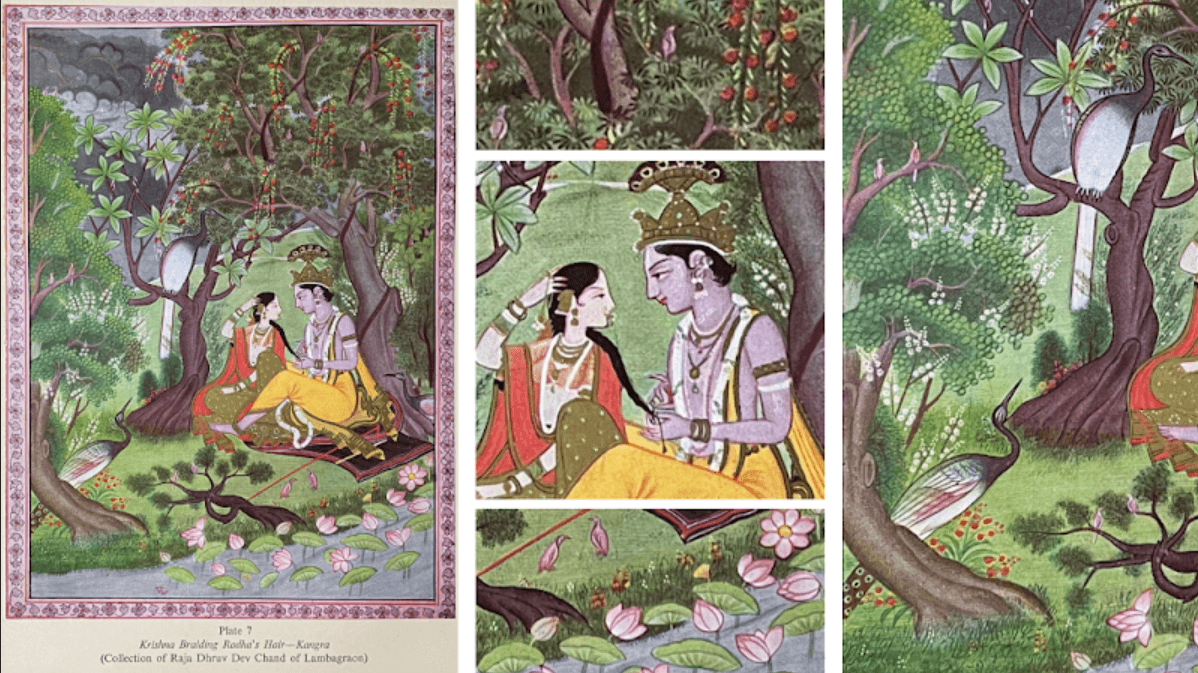
Krishna has spread his dark blanket on the ground, and the Divine Lovers rest on it. A chakora (a bird that feeds on moonlight, also believed to be a reincarnation of Vishnu) appears in the foreground, where there is a lake full of lotus flowers and leaves. Peacocks are in the foreground and on the tree and dark clouds can be seen in the sky. Krishna wears a white garland and a crown decorated with peacock feathers. He is braiding Radha's hair, while she looks at him as does the thirsty chataka at the rain clouds, (a chataka is a bird that only drinks water during the monsoons, and stays thirsty all year round) a metaphor of Radha’s longing for Krishna.
In a miniature from Guler, a gem of Kangra art, Radha and Krishna are shown sitting on the top of a mountain, sheltering from rain under one umbrella. A storm bends the branches of the trees, lightning shines in the dark clouds and rain pours from above. The peacock cries with joy, and Radha clasps Krishna, afraid of the rumbling thunder.
“The terrible storm of the month of Māgha came in its strength, breaking and bending and beating the trees,
The groves pleased not, cold prevailed, both were afraid, and under one cloth she clung to Syāma,
Now did the shaft of Hari and Radha's umbrella bend aside, and from the gathering clouds fell heavy rain,
When day re-appeared, there as it were in a single picture shone resplendent the beauty of the Three Worlds.”
In the strong storm of Māgha, trees were broken and bent. It was so cold that neither the groves nor the Radha and Krishna found comfort, and they sought shelter under one umbrella. During the storm, Radha and Syama, two lovers, huddled together. Suddenly, Lord Hari's and Radha's umbrella were pushed aside by the rain pouring from the gathering clouds. When the day returned, the beauty of the Three Worlds shone brilliantly, like a beautiful picture. In context of Vaishnavism, the three worlds here symbolise, bhur (the human body, earth, physical realm, existence), bhuva (the vital energies, heaven, consciousness) and suvah (the soul, inner space, spiritual realm, bliss) Kangra Miniature Painting is the language of human love. In a rich vocabulary of line and colour if you read the paintings intimately, the Kangra paintings express the emotions and the beauty of the people. And if you’re lucky enough, the painting talks right back to you.
Adhya Singh
Bibliography
Randhawa, Kangra Valley Painting Mohinder Singh. Kangra Valley Painting. Delhi, India: Ministry Of Information and Broadcasting, Government Of India, 1954.
“CFP Perspectives Lecture Series: Prof. B. N. Goswamy.” Interview by CFP Perspectives Brijinder Nath Goswamy. Youtube. Accessed October 4, 2023. https://www.youtube.com/watch?v=JyBl7TPaxBs.